Lukki Complaints and Reviews: What Recent Player Reports Actually Show
 Available in US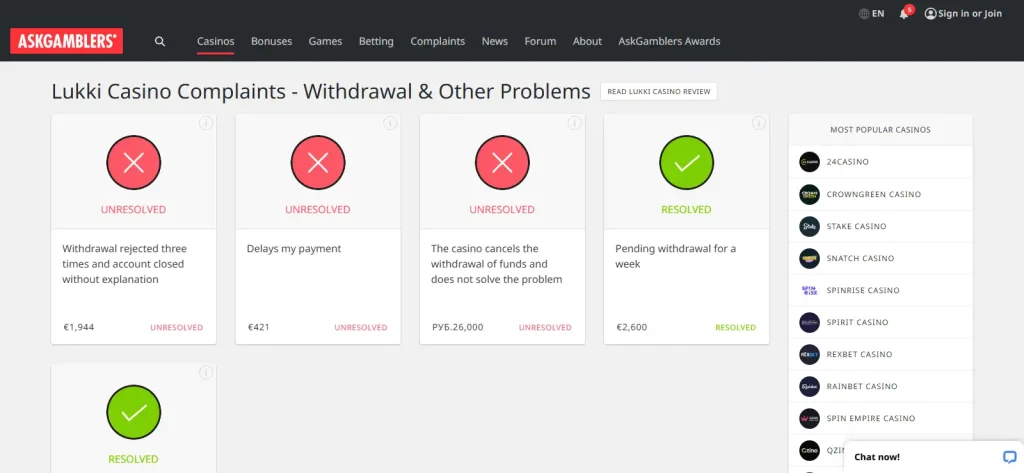
Reputation signals
Recent Lukki reviews are mixed, and they should be treated as anecdotal evidence rather than proof of how every account will be handled. Current AskGamblers complaint pages include reports about delayed or rejected withdrawals, verification or account-detail disputes, communication problems and cases that were later marked resolved. Trustpilot likewise shows both negative cash-out and support reports and positive comments about successful withdrawals, games, promotions and support. These patterns can help a reader identify what to check before using an account, but they cannot establish a payout rate, average withdrawal time or universal customer-service quality. The stronger regulatory facts sit elsewhere: ACMA has taken enforcement action involving Lukki in Australia, including a 2026 formal warning to Just Entertainment B.V. ACMA enforcement is a regulator record, while individual reviews describe personal experiences.
Table of Contents
- What the current complaint surface contains
- Withdrawal delays and rejected cash-outs are recurring themes
- Verification and account-detail disputes appear alongside payment complaints
- Support responsiveness is reported both positively and negatively
- Positive reports matter, but they have the same limitations
- What platform ratings can and cannot tell you
- Selection bias makes complaint pages look different from ordinary usage
- Regulatory evidence belongs in a different evidence tier
- A practical way to use review data before making a decision
- How Lukki player reports differ from regulatory records
What the current complaint surface contains
AskGamblers’ current Lukki complaint area displays five complaint cases in its visible summary. At the time of this check, two were marked resolved and three were unresolved. The visible cases are not all recent, and they do not all describe the same problem. Some concern withdrawal delays, one describes repeated withdrawal rejection and an account closure, and another older case centres on a payment-method problem involving cryptocurrency and RUB.
The useful information is the pattern of topics, not a headline number. A small complaint set cannot represent the experience of every Lukki customer, and a complaint platform naturally attracts users who have encountered a problem. Even the status labels need context: a case marked resolved can still contain criticism about the time taken or communication during the process.
Withdrawal delays and rejected cash-outs are recurring themes
The strongest recurring theme on the AskGamblers surface is withdrawal friction. A 2026 unresolved complaint describes repeated rejection of a cryptocurrency withdrawal, a dispute over registration information and difficulty obtaining a detailed response. Older cases include a payment marked pending for several days and another complaint about a withdrawal route becoming unavailable.
Those accounts should be described as allegations or player reports, not as established facts about Lukki’s standard processing. The complaint platform records what the user submitted and, in some cases, discussion between the platform, the player and the operator. It does not give us a complete transaction record for every case.
There is also a different outcome within the same complaint platform. One older withdrawal complaint was later marked resolved after the player reported being paid. That does not prove that withdrawals are generally fast, but it is relevant because it shows why a page should not flatten every complaint into a single negative conclusion.
For factual withdrawal mechanics, use the withdrawal guide. It deliberately avoids turning complaint timelines into official processing-time claims.
Verification and account-detail disputes appear alongside payment complaints
Recent complaint text also links withdrawal problems with verification or account-detail questions. In the August 2026 AskGamblers case, the user says Lukki referred to information not matching registration details but did not clearly identify the discrepancy. That statement comes from the complainant and should remain attributed to the complainant.
This theme is still useful for preparation. The official Lukki privacy policy, covered on the verification page, confirms that identity, proof-of-address and financial information can be used for account verification, payment handling, anti-money laundering and fraud-prevention purposes. That official policy does not validate any specific complaint, but it explains why matching registration information and payment ownership can matter during account review.
A reader who wants to reduce avoidable friction can check that account details are accurate before depositing or requesting a cash-out, and can keep requested identity or payment evidence available. That is practical risk control, not a claim that a particular complaint was caused by user error or operator error.
Support responsiveness is reported both positively and negatively
Support is another area where review evidence conflicts. A recent Trustpilot review complains about waiting more than 48 hours for an answer, while other Trustpilot reviews praise helpful or responsive support. The AskGamblers complaint set also includes users who say they received generic replies or had difficulty getting a substantive explanation.
These reports do not establish a reliable average response time. Reviewers contact support through different channels, at different times, for different types of problems. A routine question and a compliance-related withdrawal review are not comparable cases. The more defensible conclusion is simply that support experience varies across the visible reports.
For a reader, the practical response is to preserve a clear record of important account conversations. Keep dates, ticket numbers where available, transaction references and copies of requested documents. If a dispute develops, that record is more useful than relying on memory or a public review written after the fact.
Positive reports matter, but they have the same limitations
Trustpilot’s current Lukki page also contains positive reviews. Visible examples mention a successful withdrawal, a smooth identity process, game selection, promotions and helpful support. These reports are useful because they prevent a complaints page from becoming a one-sided collection of negative anecdotes.
They should be treated with the same caution as negative reviews. A five-star account of a fast cash-out does not prove that another user’s withdrawal will follow the same path. Different payment methods, verification states, jurisdictions, account histories and transaction sizes can lead to different experiences. Public review platforms do not establish every operational detail behind an individual account story.
The goal is therefore not to decide whether positive or negative reviewers are “right” as a group. It is to identify repeated themes and then check which parts can be anchored to primary evidence.
What platform ratings can and cannot tell you
Trustpilot displays more than one thousand Lukki reviews and a score above four out of five. AskGamblers displays a much smaller complaint set alongside its own casino-review information. Those two surfaces are built for different purposes, so their numbers should not be merged into a combined reputation score.
| Signal | What it can show | What it cannot prove |
|---|---|---|
| Trustpilot review volume and score | How users who posted on that platform rated the business at that time. | The experience of all Lukki users or Australian users specifically. |
| AskGamblers complaint cases | Published disputes and whether the platform later marked some cases resolved or unresolved. | A true withdrawal failure rate or the outcome of transactions that were never reported there. |
| Individual review text | The reviewer’s account of a specific experience. | Independent proof that every factual allegation in the review is correct. |
| Regulator publications | Documented regulatory findings or enforcement actions. | Whether an unrelated individual complaint is true. |
This separation is the most important part of reading reputation data. Review platforms show user-reported themes, while ACMA records cover Australian enforcement and regulator action.
Selection bias makes complaint pages look different from ordinary usage
People are more likely to post when something unusually good or unusually bad happens. That selection effect means public reviews are rarely a random sample. Complaint portals are even more concentrated because their purpose is to surface disputes that need help or mediation.
There can also be geographic mismatch. A review from Canada, New Zealand or Europe may describe a payment method, promotional rule or account pathway that does not match an Australian user’s situation. A page about Lukki Australia should therefore avoid treating a foreign review as proof of an AU-specific payment feature or legal position.
Timing matters too. Casino interfaces, operators, payment processors and terms can change. A two-year-old complaint may still reveal a type of issue worth checking, but it should not be used as evidence for a current exact limit, current processing time or current cashier method.
Regulatory evidence belongs in a different evidence tier
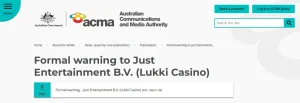
Australia has regulatory records involving Lukki. ACMA has published website blocking action involving Lukki and a 2026 formal warning to Just Entertainment B.V. for prohibited and unlicensed regulated interactive gambling services involving Lukki Casino. Those are regulator statements, not user allegations.
The Lukki licence and legal status explains those records in detail and separates Lukki’s Curaçao licence from Australian authorisation. This reputation page does not use a Trustpilot review to prove an ACMA issue, and it does not use ACMA action to validate a reviewer’s withdrawal story. The records address different questions.
A reviewer may use strong labels, but those labels remain part of the individual review. ACMA enforcement records and Lukki’s published account terms are separate from a reviewer’s characterisation.
A practical way to use review data before making a decision
Review data is most useful as a checklist generator. If repeated reports mention withdrawal reviews, verification or support communication, a reader can turn those themes into specific checks before depositing rather than trying to predict an outcome from a star score.
- Check identity details early. Make sure the account information matches the evidence you can provide if verification is requested.
- Check the current cashier. Use the live account interface for current payment routes instead of assuming a method mentioned in an old complaint is still available.
- Keep transaction records. Save deposit and withdrawal references and any important support correspondence.
- Separate timing anecdotes from official terms. A reviewer’s one-day payout or ten-day delay is not a published service standard.
- Read resolved cases as well as unresolved ones. The process and final outcome can be different parts of the same complaint.
- Use regulatory sources for legal questions. ACMA, not a review score, is the relevant source for the Australian legal framework.
For the broader site-level decision points, see the Lukki Australia FAQ and the Lukki Australia review.
How Lukki player reports differ from regulatory records
Current Lukki review surfaces contain both positive and negative player reports, with recurring discussion around withdrawals, verification and support. Those reports can highlight questions worth checking, but they are not a statistically representative sample and should not be converted into a payout-reliability score. User reviews describe individual experiences, complaint platforms document disputes, Lukki’s account terms describe operator rules, and ACMA publications record Australian regulatory action. These categories answer different questions and should not be collapsed into one reputation score.
Recommend

Lukki Australia FAQ: PayID, Tax, BetStop, Support and Common Questions
Lukki Australia Guide Australia FAQ and decision guideThe main Australian questions concern payments, BetStop scope,...

Lukki Casino Bonuses in Australia: Current Offers, Wagering and Terms
Lukki Australia Guide Bonus guide for AustraliaLukki promotion pages set out the deposit amount, code,...
Lukki Payments in Australia: AUD Deposits, Cashier Methods and the PayID Gap
Lukki Australia Guide Payments and cashier guideLukki's AU payments area displays AUD methods, payment categories,...

Lukki Casino Games and Pokies: Library, Providers and AU Restrictions
Lukki Australia Guide Games and pokies guideLukki organises its casino catalogue into categories and provider...
Lukki Licence in Australia: Curaçao, ACMA and the Interactive Gambling Act
Lukki Australia Guide Licence and legal statusThe primary Australian regulatory evidence is ACMA's formal warning...

Lukki Mobile Casino in Australia: Browser Access, Home-Screen Use and App Status
Lukki Australia Guide Mobile casino guideThe Lukki AU website adapts its navigation, game lobby and...

Lukki Registration in Australia: Sign-Up Flow, Account Checks and Key Caveats
Lukki Australia Guide Account guideLukki registration begins with the account form and continues into email...